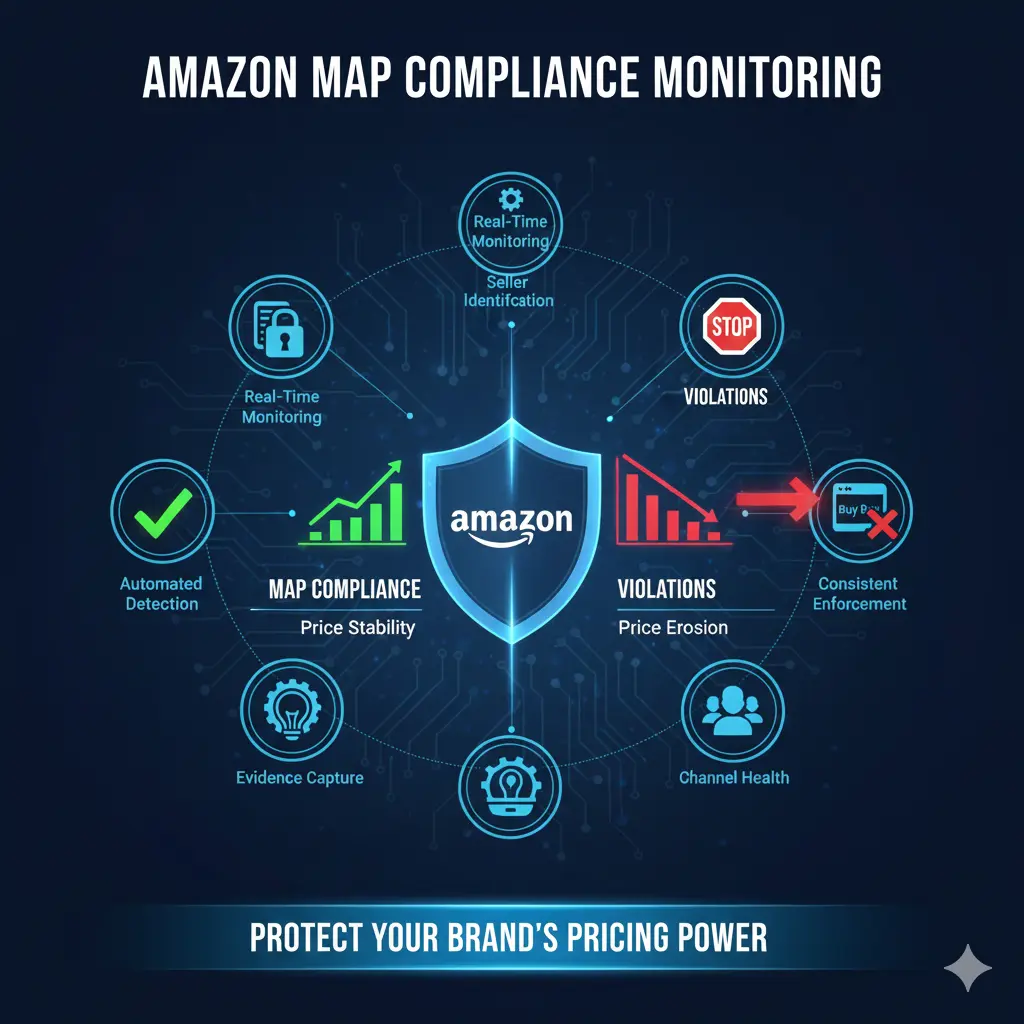
Amazon MAP compliance monitoring is no longer optional for brands that care about pricing control and channel health. Once your products start selling at scale, unauthorized discounting, silent price erosion, and Buy Box manipulation become almost inevitable, even when you have clear MAP policies in place.
On Amazon, MAP violations rarely look obvious. Prices drop for a few hours, resellers rotate in and out, and the Buy Box shifts before anyone on your team notices. By the time a violation is spotted manually, the damage is already done, lost margin, upset authorized sellers, and weakened brand positioning.
This article explains what Amazon MAP compliance monitoring actually means, how MAP violations happen in real marketplaces, and why brands need continuous, ASIN-level visibility to enforce pricing consistently without turning enforcement into a full-time job.
What Is Amazon MAP Compliance Monitoring
Amazon MAP compliance monitoring is the process of continuously tracking product prices on Amazon to ensure sellers follow your Minimum Advertised Price policy. It is not about setting prices, Amazon does not allow that. It is about visibility, detection, and enforcement when advertised prices fall below what your brand allows.
MAP policies exist to protect brand value, margins, and fair competition among authorized sellers. On Amazon, however, pricing moves fast. Sellers change prices multiple times a day, often using repricing software that reacts to competitors instantly. This makes manual monitoring ineffective.
MAP compliance monitoring focuses on:
Tracking advertised prices at the ASIN level
Identifying sellers violating MAP
Capturing evidence when violations occur
Enforcing policies consistently across sellers and marketplaces
One of the biggest misconceptions is that MAP enforcement is only needed when problems appear. In reality, brands that wait until pricing collapses usually struggle to recover. MAP monitoring is preventative by nature.
Another misconception is assuming Brand Registry prevents MAP violations. Brand Registry protects content and intellectual property, not pricing behavior. MAP enforcement requires its own system, process, and discipline.
Without monitoring, brands operate blind. Prices erode silently, authorized sellers lose trust, and margins shrink before anyone notices.
How MAP Violations Happen on Amazon
MAP violations on Amazon rarely happen because sellers want to hurt your brand. Most happen because the system rewards price drops.
Repricing tools are one of the biggest drivers. Sellers set automated rules to win the Buy Box, match the lowest price, or beat competitors by small increments. When one seller drops below MAP, others follow automatically.
Common violation sources include:
Unauthorized sellers sourcing through gray markets
Liquidation inventory re-entering Amazon
International sellers dumping inventory
Authorized sellers prioritizing volume over compliance
Short-term discounts used to spike sales velocity
MAP violations also happen in short bursts. A seller may violate MAP for a few hours, win the Buy Box, clear inventory, and then disappear. By the time a brand checks manually, pricing looks normal again.
Another issue is seller rotation. One violator leaves, another appears. This creates the illusion of isolated incidents when the problem is systemic.
MAP violations are rarely static. They are dynamic, frequent, and often coordinated by algorithms rather than humans.
Common Signs of MAP Non-Compliance
MAP violations do not always announce themselves clearly. Most brands first notice indirect symptoms.
Pricing behavior is the biggest signal. If your products regularly sell below expected margins without approved promotions, MAP is likely being violated.
Other warning signs include:
Buy Box price instability
Complaints from authorized resellers
Increased pressure to match lower prices
Sudden drops in average selling price
Channel conflict with distributors
Customer perception also changes. When prices fluctuate aggressively, customers delay purchases, expect discounts, or question product value.
Internally, teams feel the impact:
Sales blames distribution
Marketing blames pricing
Operations blames Amazon
Nobody has clean data to prove the cause
If MAP enforcement relies on screenshots, spreadsheets, or occasional checks, violations are already happening more often than you think.
The Business Impact of MAP Violations
MAP violations hurt more than margins. They damage the structure of your entire Amazon operation.
The first impact is price erosion. Once a lower price becomes visible, it resets customer expectations. Raising prices back becomes difficult without losing conversion.
Next comes channel conflict. Authorized sellers lose trust when violators are not enforced against. Over time, good partners disengage or violate MAP themselves to survive.
Brand positioning also suffers. Premium brands lose credibility when pricing becomes inconsistent. Even mass brands feel pressure when pricing chaos replaces predictability.
Operationally, MAP violations create constant firefighting:
Manual seller outreach
Inconsistent enforcement
Emotional negotiations
No historical violation tracking
Long term, MAP breakdowns weaken negotiating power with distributors and retailers. Amazon becomes the lowest price channel instead of a strategic one.
MAP violations are not a pricing problem. They are a control problem.
How to Monitor and Enforce MAP Compliance on Amazon
Effective MAP compliance requires three things: visibility, evidence, and consistency.
Visibility means tracking prices continuously, not occasionally. Brands need to know:
Which ASINs are violating MAP
Which sellers are responsible
When violations start and end
Evidence matters because enforcement without proof fails. Screenshots, timestamps, seller IDs, and pricing history are critical.
Consistency is what separates serious brands from ignored ones. Sellers test enforcement. If actions are slow or inconsistent, violations increase.
A strong MAP workflow includes:
Real-time price monitoring
Automated violation detection
Seller identification
Documented enforcement steps
Escalation when violations repeat
Manual enforcement does not scale. As catalogs grow, monitoring must become systematic.
How AxleIT Simplifies Amazon MAP Compliance Monitoring
MAP compliance only works when monitoring is continuous and enforcement is structured. AxleIT was built to give brands that control without turning MAP into a full-time job.
AxleIT tracks MAP violations at the ASIN level in real time, identifies violating sellers, and captures evidence automatically. Instead of reacting to complaints or checking prices manually, brands see violations as they happen.
The platform also brings consistency to enforcement. Violations are logged, outcomes are tracked, and repeat offenders become visible. This allows brands to enforce MAP fairly, confidently, and at scale.
AxleIT turns MAP compliance from a reactive headache into a controlled system. For brands serious about protecting margins, reseller relationships, and brand value on Amazon, that visibility makes all the difference.
Book your free demo now & see in action how brands use AxleIT to monitor MAP compliance in real-time.
